

What a habitation check report records, and why to keep every year's
A habitation check is the annual service for the living area of a motorhome. It is separate from the van's own servicing, and it produces two documents: a check sheet and a damp report. This guide covers what each records and why to retain every year's copy.
Who does the check
The Approved Workshop Scheme (AWS) is a joint enterprise of the National Caravan Council, the Caravan and Motorhome Club and the Camping and Caravanning Club. It approves workshops to carry out routine annual servicing of the habitation unit of a motorhome. It does not cover the base vehicle.
The scheme says leisure vehicles should be serviced on an annual basis, even if a motorhome is used only a couple of times a year. It says a motorhome habitation service takes around three hours.
What the check covers
The Camping and Caravanning Club says the AWS annual service carries out over 40 separate checks across the gas, electrical and appliance systems. The club says fridges, cookers and heaters are normally only checked for correct functioning.
At the end you receive a service checklist that itemises every point checked. The scheme provides specific checklists for tourers and for motorhomes, and a damp report with every service.
What the damp report records
The scheme's sample motorhome damp report shows how the second document is laid out. Readings are taken at 300mm intervals. The sheet records the damp meter make and model, the meter's calibration check figure, the weather and the ambient temperature. The technician and the customer both sign it.
The report prints guidance notes written by the scheme. One of them says only readings over 15% are recorded. They are the scheme's words about its own report, and this guide does not adopt them as a standard.
Two more lines on the sheet matter to an owner. Only the inside of the habitation unit is tested, and personal belongings are not removed from lockers, which may limit the scope of the report. The readings may also be subject to atmospheric conditions.
Why one report is a snapshot
A single damp report tells you what a meter read on one day, in one kind of weather, behind whatever was in the lockers. Three consecutive reports let you see whether the same corner held, rose or fell, with the dates of any repair beside them. A single report gives no trend.
Because the report records only readings over 15%, a dry van's sheet can arrive with nothing on it. Keep it anyway. A dated blank report records that a check took place.
Why every year
Warranty is a practical reason. The scheme says that if a leisure vehicle is under warranty, it requires servicing within a stipulated time for the warranty to continue. The Camping and Caravanning Club notes that manufacturers' warranty schemes generally insist on at least an annual service. A run of dated check sheets is the paperwork that records those visits.
Resale is the other. A buyer reading a run of sheets can see that the van was looked at every year, by whom, and what each visit recorded. A single report gives no evidence for earlier years.
Keeping them
Photograph each check sheet and damp report the day you collect the van. Name the file with the date and the workshop. Write the meter reading for each location in the same order every year, so each location reads down one column.
Keeping every year in NomadStamp
NomadStamp keeps one record per habitation visit: the dates, the workshop, the cost, what was carried out, and the check sheet line by line. A habitation check sits on the Habitation tab as a single record, with its attached invoice and certificate photographs. Each register says how many records it holds and what it last received.

Log damp readings by location across every survey, with the meter and the engineer. NomadStamp keeps every damp reading, year by year, exactly as the engineer wrote it. A survey with no readings recorded is stored as exactly that. Here are two rows from the sample pack's damp matrix.
| Location | Survey 1 | Survey 2 | Survey 3 | Survey 4 | Survey 5 | Survey 6 | Survey 7 |
|---|---|---|---|---|---|---|---|
| Rear nearside lower corner | 18 | 18 | 20 | 23 | 19 | 17 | 17 |
| Rear offside lower corner | 16 | 15 | 16 | 17 | 16 | 15 | <10 |
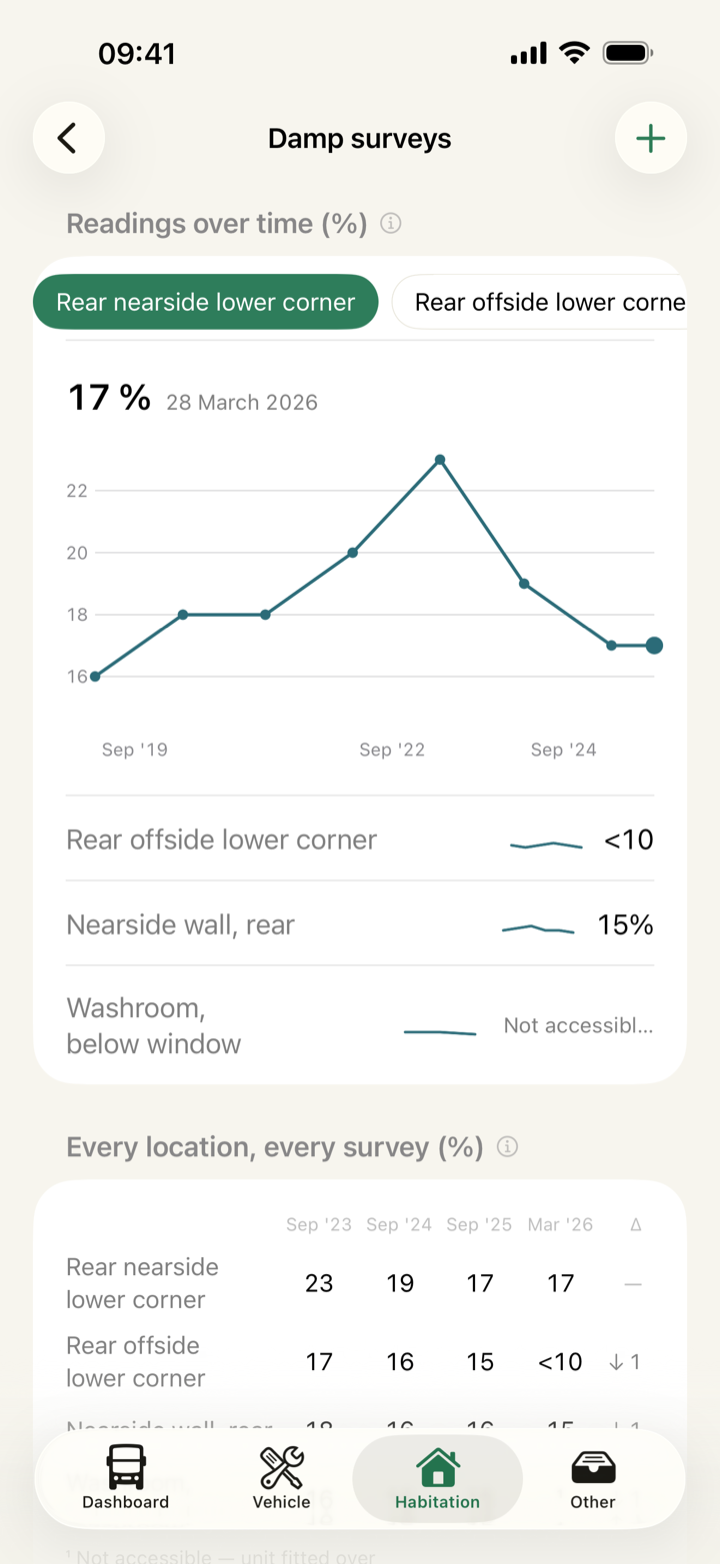
The sample pack prints each survey under the habitation check it was part of. Annual Record Coverage is a grid of what you have entered year by year, and a blank year means nothing was entered rather than that nothing happened.
Record each appliance with its make, model, serial number, fitted and removed dates, and a photo of the rating label. See the features page for the rest of the registers.
NomadStamp is a record-keeper, not an advisor. It never tells you whether something is due, safe or legal, and it never works a date out of a damp reading, a tyre code or a service record. It stores what you and your service centre recorded, and it displays it without alteration.
NomadStamp. Log maintenance, track key dates, and consolidate all your paperwork on your phone. Export everything as one searchable PDF. Get NomadStamp on the App Store. Price and requirements are on the home page. Read the sample resale pack (PDF).
Related guides
- The paperwork a motorhome buyer asks for: The documents a buyer expects to see, from the V5C to the damp report, and the source that explains each.
- The NomadStamp logbook app: what it keeps and how it exports.
- All guides
Sources
Each source is named and linked. Where a rule or a figure can change, this guide points to the source rather than repeating it.
- Approved Workshop Scheme: who runs the scheme and what it approves
- Approved Workshop Scheme, FAQs: annual servicing, documents, warranty and duration
- Approved Workshop Scheme, sample motorhome damp report: how a damp report is laid out and what it records
- The Camping and Caravanning Club, servicing advice: the number of checks, damp testing and manufacturers' warranties
- National Caravan Council: one of the three bodies behind the scheme
Sources last checked: October 2026